Jorge I. Casares Zambrano · Books · August 2026
The books that shaped me
A selection of the books I reread often, and that shaped how I think about investing, strategy, and leadership.
Essay
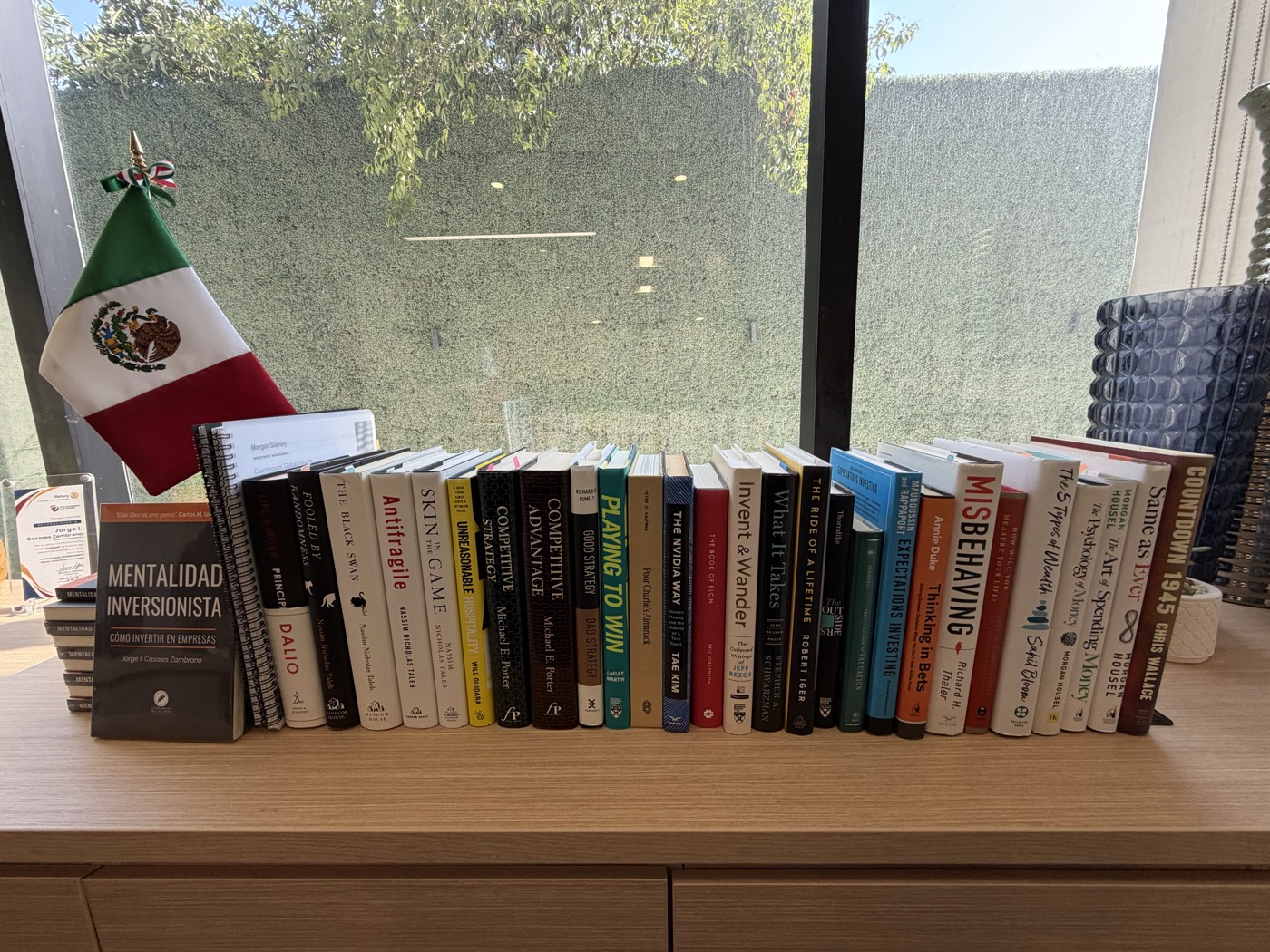
If you read and reread a book with real attention, it should belong on your résumé. Just as you're said to be the average of the five people you spend the most time with, spending hours with a book shapes you. Here I want to share a list of books that have shaped me, and whose notes I try to reread often.
The basics
- Principles, by Ray Dalio. He's a great investor, a student of history, and above all a great designer of organizations. This is where I learned to develop my investment principles and put them to the test in every interaction, so the process can be verifiable, improved, and scaled.
- The Incerto series, by Nassim Taleb. It's an intense read. Every paragraph has value: original ideas that apply to life, business, politics, investing. It helped me understand that we can't control everything in life —chaos is inevitable— and that we need to prepare organizations and people to survive whatever scenario comes (start with Antifragile).
- Unreasonable Hospitality, by Will Guidara. A very complete book; through its story it covers strategy, culture, leadership, and how to do work with excellence. Doing good work isn't the same as doing excellent work: excellence requires hard choices that ultimately lead to a better path.
- Michael Porter's books and papers. The foundation of every relevant business book, especially paired with Roger Martin (Playing to Win) and Richard Rumelt (Good Strategy Bad Strategy). That's where the difference between operating and choosing strategically becomes clear: a company's leaders must decide where to take it and give up other paths to focus resources well.
Warren Buffett and Charlie Munger deserve an Honorary Mention of Excellence: their letters, videos, books, all of it.
To improve as an investor-CEO
- The Nvidia Way. Jensen Huang's intensity, practicality, and courage are inspiring for any CEO. His level of intensity is hard to match, but it was the courage to beat the innovator's dilemma (The Innovator's Dilemma) that took the company to this impressive level of profits.
- Invent and Wander, with Jeff Bezos's letters. A business genius: he understands when to invest, the right speed for making decisions, and long-term thinking.
- The Book of Elon. A manual for how Musk works and how to run companies and solve the problems that inevitably come up. It makes clear that a company's leaders must focus on removing bottlenecks and directing the organization.
- What It Takes. The story of Blackstone. If you want to get into private equity, it's a great guide.
- The Ride of a Lifetime, by Bob Iger. The book by Disney's legendary CEO. This is where you learn the human side of making deals. The acquisitions that defined the company are great case studies, and he shares his rational vision for steering a global company.
- How to Make a Few Billion Dollars, by Brad Jacobs. Probably one of the best dealmakers of the era: he's made more than 500 acquisitions to build incredible companies.
- The Outsiders. Explains what finance ought to be: how to use it to maximize returns, not ego.
To improve on the technical side of investing, nothing beats reading Michael Mauboussin's papers: the perfect mix of academia and practice. Pair that with Aswath Damodaran's classes and books, the dean of valuation: the foundations for understanding a business's real value.
As leaders of companies, our most important job is to make the best possible decisions, and only about three of those come along each year. To sharpen judgment: Thinking in Bets, by Annie Duke; Misbehaving, by Richard Thaler; and Morgan Housel's three books. The latter are more for reflecting on the relationship between money, work, and life.
For a fuller life and to perform better in every area that matters: 5 Types of Wealth and How Will You Measure Your Life?, both 10/10. They help put what matters in life into perspective.
Cross pollination
Studying the history of large projects that required many people, a lot of coordination, and a lot of training: Countdown 1945 and Countdown bin Laden, by Chris Wallace, tell the stories of great projects that shaped world history. How they coordinated such a large group of people toward a single mission is inspiring.
Another hugely valuable source of knowledge is the right podcasts: I've listened to most episodes of Founders and Acquired, some more than twice. They hold great lessons from entrepreneurs, leaders, and the companies they built. Learning from history is key because history repeats itself: it's learning in other people's shoes to grow faster.
I like to treat these readings like a recipe or a cocktail: reading two at the same time sparks genuinely interesting new ideas. For example, reading Morgan Housel and Aswath Damodaran together to understand greed or fear in price and its distance from value.
My goal is to be a great activist investor, and I've mapped out my path to keep improving every day. To get there I need to develop in finance and accounting, statistics, sales and negotiation, how to be a better CEO, culture and decision-making, and to a lesser degree, economics, law, tax, and technology.
Over time this list will keep getting updated, but today these are a big part of how I think about activist investing.
We stand on the shoulders of giants. A traditional résumé says where you studied and where you've worked, but it says little about the ideas you've spent hundreds of hours with.
If you reread a book, underline it, take notes, discuss its ideas, and end up making different decisions because you read it, that author was one of your teachers too. That's why I believe our library should be part of our résumé. This is, for now, mine.
This section
This is where I publish essays and reviews on the books I read —mostly investing, strategy, and financial history— written to understand what I read better, not to summarize it. For now there is a single entry, the one above; once there are more, this page will go back to listing all of them.